Code Name God by Mani Bhaumik
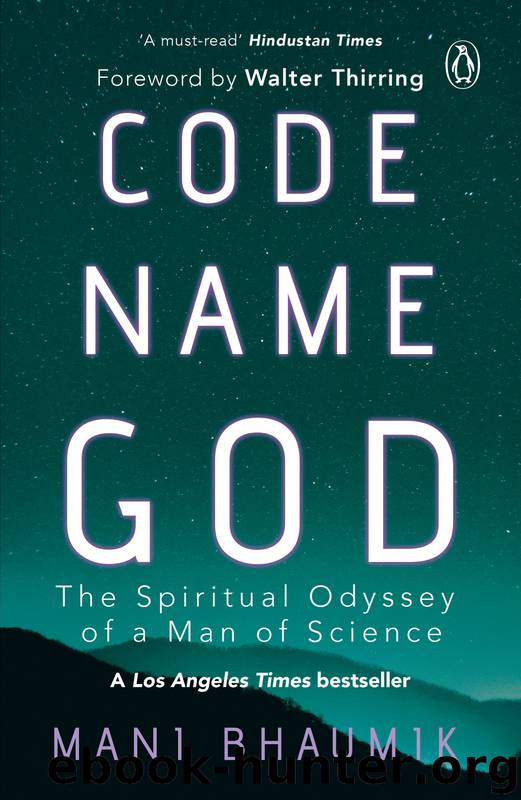
Author:Mani Bhaumik
Language: eng
Format: epub
ISBN: 9789387326613
Publisher: Penguin Random House India Private Limited
Published: 2017-12-11T05:00:00+00:00
12
Turning to the Source
I BEGAN, during this introspective period, to explore the common elements of the world’s great religions. It struck me that knowledge had probably developed much as a living organism does, branching off endlessly from a primal seed, and that science (more precisely, scientism), in excluding God from its calculus, had cut off its roots.
Like an epidemiologist searching for the carrier of a virus or a detective trying to identify a common M.O. in a series of crimes, I would look for spiritual links in the manner of a scientific sleuth. But even the great Sherlock Holmes might have run into a blind alley if not for those allies (including Dr. Watson) who offered him guidance and clues. The loss of lifelong friendships to which I alluded earlier might have handicapped my quest had it not been for the restorative influence and steadfast presence in my life of three remarkable new friends.
Eddie Albert, the great vaudevillian and comic actor who had, oddly enough, portrayed Eva’s determined husband on Green Acres, remained my good friend long after the party lights had dimmed. I was introduced to Eddie, not by a talent agent or another Hollywood star, but by Deepak Chopra, the hugely successful author and spokesman for the Human Potential Movement. Chopra had held the West Coast release party for his book Quantum Healing in my Moraga Place mansion, and soon after, his friend Eddie Albert and I discovered a kinship in laughter, trust, and a determination to stay light on our feet. Eddie’s sense of humor leavened my sober nature and, as we shall soon see, laughter has healing and antidepressant properties that can go far beyond the advertised effects of Prozac.
The late, great Ashley Montagu was an advocate for love in an era of abiding hatred. Anthropologist, social scientist, prolific author, and educator, he was arguably the social conscience of a generation. Ashley may have done more than any other man of his time to dispel lingering and pernicious nineteenth-century notions about racial differences. His masterful book The Fallacy of Race, published in 1942, strongly influenced the U.S. Supreme Court’s historic Brown v. Board of Education decision, which provided legal fuel for the great civil rights movement of the ’50s and ’60s. The Natural Superiority of Women (1953), needless to say, had a profound impact on modern feminism, and The Elephant Man (1971), upon which the play and later film were based, forever altered our perceptions of people with physical disabilities. Considered by many to be an heir to Darwin, he drew a critical distinction by arguing that evolution was a dynamic process involving interaction between experience and genetics: we are participants in our social and biological destinies.
Apart from his astonishing résumé, Ashley was the epitome of British erudition and wit and an advocate of “growing young,” that is, maintaining intellectual curiosity even into one’s later years. One of his characteristic quotes was, “We should die ‘young’. . . but as late as possible.” I met him in the mid-1980s, in the company of Laura Huxley, widow of another British prodigy, Aldous Huxley.
Download
This site does not store any files on its server. We only index and link to content provided by other sites. Please contact the content providers to delete copyright contents if any and email us, we'll remove relevant links or contents immediately.
The Lost Art of Listening by Michael P. Nichols(7507)
Why I Am Not A Calvinist by Dr. Peter S. Ruckman(4154)
The Rosicrucians by Christopher McIntosh(3521)
Wicca: a guide for the solitary practitioner by Scott Cunningham(3180)
Signature in the Cell: DNA and the Evidence for Intelligent Design by Stephen C. Meyer(3140)
Real Sex by Lauren F. Winner(3025)
The Holy Spirit by Billy Graham(2954)
To Light a Sacred Flame by Silver RavenWolf(2824)
The End of Faith by Sam Harris(2744)
The Gnostic Gospels by Pagels Elaine(2536)
Waking Up by Sam Harris(2461)
Nine Parts of Desire by Geraldine Brooks(2370)
Jesus by Paul Johnson(2363)
Devil, The by Almond Philip C(2334)
The God delusion by Richard Dawkins(2312)
Heavens on Earth by Michael Shermer(2285)
Kundalini by Gopi Krishna(2185)
Chosen by God by R. C. Sproul(2165)
The Nature of Consciousness by Rupert Spira(2109)
